Multi-Party Model
In the Two-Party Model, we analyzed TRAV2, the two-party traversal problem. We now study the k-party version, denoted TRAVk, with k≥2.
Definition. Let G=(V,E) be an undirected graph with designated start and end vertices v,w∈V, where ∣V∣=n. There are k players, and player i∈[k] owns a vertex subset Vi⊆V. The edge set owned by player i is Ei={(a,b)∈E∣{a,b}∩Vi=∅}. Thus player i owns a subgraph Gi=(Vi,Ei). Given a fixed G, start vertex v, and end vertex w known to all players, an instance of TRAVk is defined as follows: TRAVk(G1,…,Gk):({0,1}n)k→{0,1}, where TRAVk(G1,…,Gk)=1 if there is a path from v to w in ⋃i=1kGi, and TRAVk(G1,…,Gk)=0 otherwise.
Definition. The k-party disjointness problem DISJk is defined as follows: each player i∈[k] has input x(i)∈{0,1}n, interpreted as a subset Si={j∈[n]∣xj(i)=1}⊆[n]. Define DISJk(x(1),…,x(k)):({0,1}n)k→{0,1}, where DISJk(x(1),…,x(k))=1 if ⋂i=1kSi=∅, and DISJk(x(1),…,x(k))=0 if ⋂i=1kSi=∅.
It is well known that D(DISJk)=Ω(nk) and R(DISJk)=Ω(nk) [Braverman et. al, 2013].
Claim. TRAVk is at least as hard as DISJk. Furthermore, D(TRAVk)=Θ(nk) and R(TRAVk)=Θ(nk).
Proof. Let (x(1),…,x(k)) be an input to DISJk with x(i)∈{0,1}n. The high-level idea is similar to the two-party disjointness reduction: we build a TRAVk instance from a chain of n multi-party disjointness gadgets.
Multi-party disjointness gadget. For each index j∈[n], create vertices Lj, Rj, and Mj. All players own Lj and Rj. Furthermore, player i owns Mj if and only if xj(i)=0. Then there is a valid path from Lj to Rj if and only if at least one player has xj(i)=0. Equivalently, there is no such path if and only if all players have xj(i)=1.
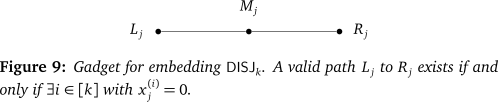
Reduction to TRAVk. We construct a graph G by chaining n copies of the multi-party disjointness gadget, connecting Rl=Ll+1 for all l∈[n−1]. Set the start vertex v=L1 and end vertex w=Rn. Then there is a path from v to w in ⋃i=1kGi if and only if every gadget is traversable (that is, there is a path from Lj to Rj for all j∈[n]). This means that for every j, there is some player with xj(i)=0, so ⋂i=1kSi=∅. In other words, a path from v to w witnesses that every element in [n] is missing from at least one subset Si.

We conclude the proof by noting that the construction uses Θ(n) vertices and edges. Hence D(TRAVk)=Ω(nk) and R(TRAVk)=Ω(nk).
For upper bounds, consider the trivial protocol where players 2,…,k send their input to player 1 in (k−1)n=Θ(nk) bits. Then player 1 can compute the answer. This trivial protocol works in both the deterministic and randomized setting. This gives D(TRAVk)=Θ(nk) and R(TRAVk)=Θ(nk).
Informally, this tells us that adding more players does not make traversal an easier problem in terms of deterministic and public randomized communication complexity.