
Two-Party Model
Deterministic Two-party Bounds
We claim that is at least as hard as two-player equality:
Claim. Recall that equality has inputs , and iff . Then , and more generally is at least as hard as .
The high-level idea of the following proof is to construct an equality gadget that lets us embed into . That is, given and as inputs of , we can convert these into subgraphs and , inputs of . We convert this in such a way that if and only if . Then cannot use less communication than the optimal protocol, else we get a contradiction.
Proof. Equality gadget. We construct a gadget that enforces equality at a single bit position at index of and , for . The gadget is shown below and consists of two parallel branches:
- The top branch corresponds to the assignment .
- The bottom branch corresponds to the assignment .
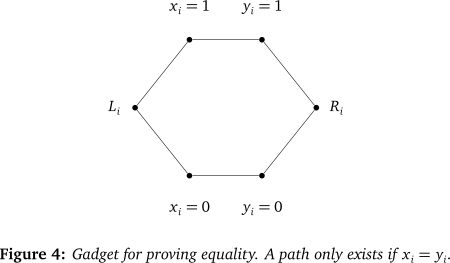
Add and into and . Then, add ownership of to if is true, else add . Do the same for Bob and . Then a path from to exists if and only if Alice and Bob have vertices on the same branch, which holds exactly when .
Embedding into . Construct a graph of equality gadgets in a chain. We do this by setting for . Construct subgraph as follows: include all vertices and for . Also, for every , give ownership of the vertex labeled if this is true, else . Repeat for and .
In the resulting graph, set as the start vertex , and as the end vertex. Then there exists a path from to if and only if all gadgets are traversable, which occurs if and only if for all , and therefore if and only if .

We conclude by noting that the resulting graph has vertices and edges. As , this completes the reduction and is at least as hard as .
The trivial protocol where Alice sends all of to Bob has communication complexity . Therefore, . Together with the Equality Claim, this gives . Thus is deterministically maximally hard.
Randomized Two-Party Bounds
Above, we note that the problem is deterministically maximally hard. In many cases, allowing for some error may allow us to produce a randomized algorithm with lower communication complexity.
Consider the public coin randomness model. In this model, both parties have access to the same random bit-string in addition to the problem description and input. This random bit string can be as long as we want. We also allow our output to error, that is, be incorrect, some bounded constant percent of the time, and strictly less than half the time. It can be shown that using the public coin randomness model, equality, which is deterministically maximally hard, can be reduced to being . We can denote the randomized communication complexity of equality by .
Unfortunately, for we find that such a bound is unattainable. To prove this, we introduce the disjointness problem , which has public coin randomized communication complexity . As we show, can be embedded into .
Definition. Define the disjointness problem as follows: let be -bit strings representing subsets of . Then, for all , if , we say is in Alice’s subset , and if it is not. Similarly for and Bob. Then , where if , and if . It is well-known that and .
Claim. We claim , and more generally is at least as hard as .
Proof. Disjointness gadget. We construct a gadget that enforces disjointness at a single entry . There, let and be indicator functions that equal 1, respectively, when and , else equal 0. Then:
- The top branch corresponds to when but .
- The middle branch corresponds to when and .
- The bottom branch corresponds to when but .
Give and to both and . Then give ownership of vertices labelled to if this is true, else give all vertices labelled . Do the same with and . Therefore, there is no path to if , but there is a path in all other cases.
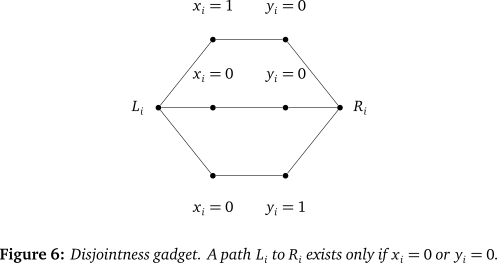
Embedding into . We construct a graph by chaining copies of the disjointness gadget. More precisely, set for . Then, set as the start vertex and as the end vertex. Construct by giving ownership of all vertices , and vertices labeled if it is true, else , for . Do similarly for .
In the resulting graph, there exists a path from to if and only if all disjointness gadgets are traversable, which occurs if and only if .

We conclude by noting that and . As , this completes the reduction and is at least as hard as .
Recall that in the equality embedding, we showed that . With disjointness, we show that too. This is because the disjointness embedding gives , since . Then, the trivial protocol where Alice sends her entire to Bob in bits works even in the public coin randomness model. Together this gives . In other words, we cannot do much better even with bounded error.
Specialized Two-Party Bounds
The previous proofs show that is maximally complicated in terms of deterministic communication complexity and public randomized communication complexity. A natural follow-up question is whether we can do better. That is, given some additional constraints, can we solve the problem with reduced communication complexity?
Definition. Define the problem as a problem where and are guaranteed to be connected subgraphs of .
Claim. is at least as hard as . Thus, and .
Proof. Let be inputs of Alice and Bob to the problem. We construct a graph as follows: give ownership of and all vertices labeled and if , for . Similarly for , , and . Then if there is a path from to , this means there exists some such that . This means that . On the other hand, if there is no path from to , then for all , either or .
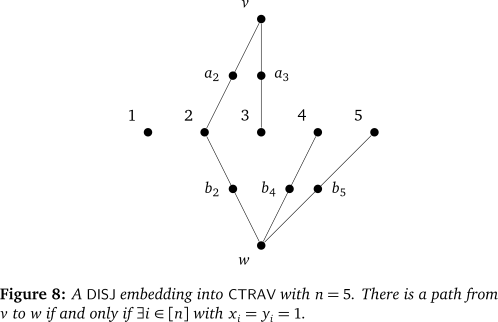
We note that . Furthermore, and are connected subgraphs of . This completes the reduction.
Informally, this tells us that even when and are connected subgraphs, we do not immediately get better bounds and the problem does not become significantly easier. We now consider a sparser case:
Definition. Define as a problem where , , and . In other words, the graph is sparse and , are sparse too.
Claim. is at least as hard as . Thus, and .
Proof. We reuse the reduction from to in the disjointness embedding. In that construction, is a chain of disjointness gadgets, so . Moreover, each player’s subgraph consists of the gadget boundary vertices and one branch choice per gadget, which also gives and .
Hence every instance produced by that reduction already satisfies the sparsity constraints in the definition of . The reduction still preserves correctness: iff there is a to path in . Therefore is at least as hard as .
Informally, this tells us that weak edge sparsity of , , and does not add nor remove significant communication cost. Combined with the connected-subgraph claim, this suggests that the local structure of , , and , namely how sparse or connected the edges corresponding to the owned vertices are, does not have a significant impact on the deterministic and public randomized communication complexity of .